
60 minutes in the pool / Roller
Learning to roll.
I'd use this hour to find a movement you can repeat comfortably. Tell the instructor what you feel, take a break when you need one and work on the part that is useful to you today.
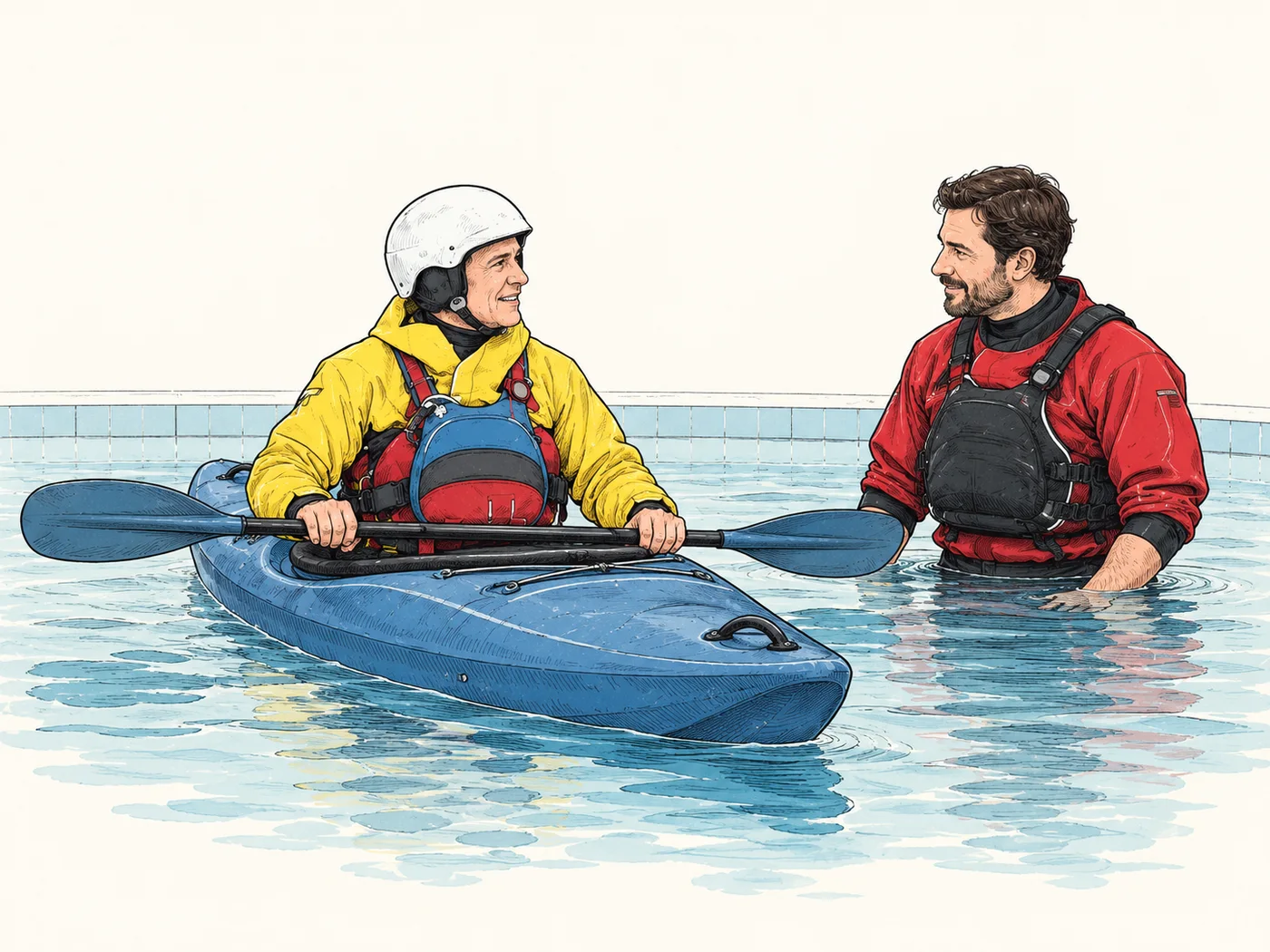
Before you start.
The times below are a way to organise the hour. Stay with an earlier exercise if it is helping, and leave the later phases for another day if needed.
- Tell the instructor about your experience, comfort in the water and anything that affects your movement.
- Ask to be shown how to stop, get help and get out of the boat before starting any capsize practice.
- Agree what contact you are comfortable with. You can change your mind during the session.
Agree a stop/help signal and permission for contact. Stop for pain, distress or loss of confidence. No solo underwater practice, breath-hold challenges or unexpected capsizes. Helpers must be shown their assistance in person.
The shared hour
Work through
what helps.
Move on when the roller is comfortable and the coach agrees. Completing every stage is not the aim of the hour.
- 010 to 8 minAgree how you will work together.
- 028 to 15 minFind the movement before adding the paddle.
- 0315 to 27 minTurn the boat with support.
- 0427 to 39 minAdd the paddle without changing the job.
- 0539 to 50 minLearn where the paddle starts.
- 0650 to 55 minFind the setup from somewhere else.
- 0755 to 60 minTalk through what changed.
0 to 8 min
Agree how you will work together.
Make sure the roller, helper and instructor understand the exercise and how to stop.
Your part / Roller
- Tell the instructor what you have tried before and what you want from today.
- Ask them to show the exit and help arrangements, then agree a clear signal and any hands-on contact.
- Start capsize practice only when the qualified coach has checked that you are ready.
Before moving on
The qualified coach confirms readiness, fit, exit arrangements and the helper briefing.
If it is not there yet
Use the hour for water confidence and supported preparation if capsize readiness is not established.
8 to 15 min
Find the movement before adding the paddle.
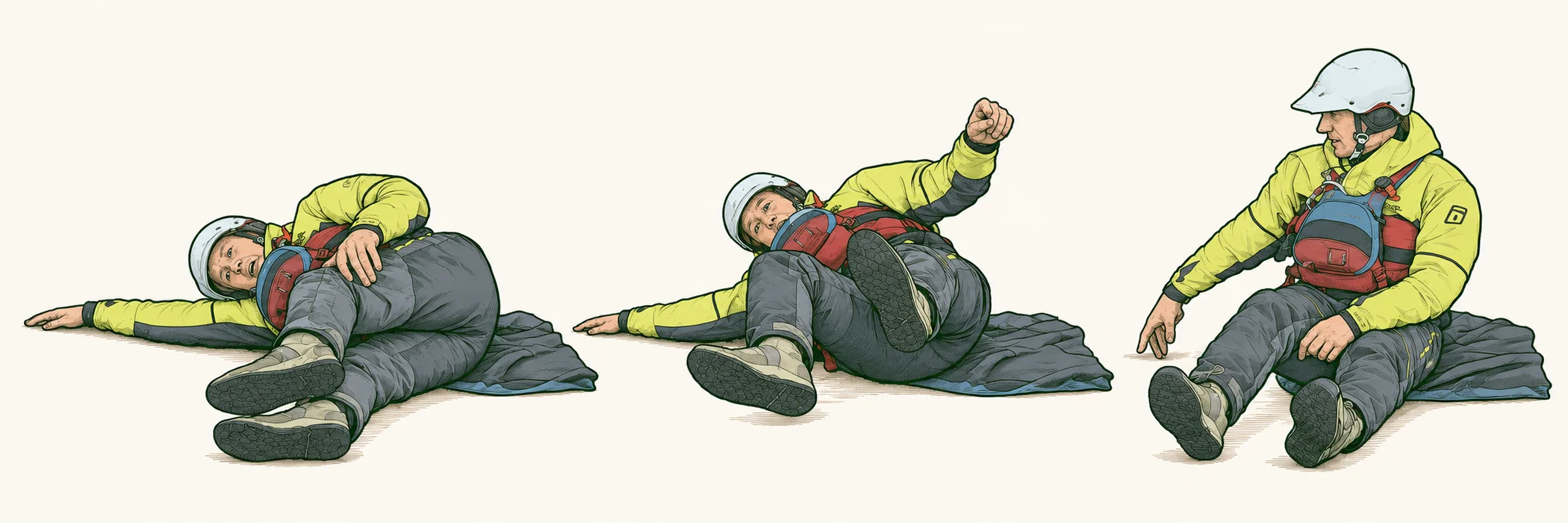
Use the earlier mat demonstration to explore body movement, then check the actual boat.
Your part / Roller
- Watch the mat example and try the comfortable variation your instructor demonstrates.
- Notice how moving your knees and body changes your position. Describe what you feel rather than trying to copy an angle.
- Once in the kayak, tell the instructor if you slide around, feel squeezed or cannot move comfortably.
Before moving on
The roller is comfortable and the coach is satisfied with the boat fit and selected exercise.
If it is not there yet
Stay with the mat or adjust the preparation with the coach. Do not spend the rest of the hour compensating for poor fit.
15 to 27 min
Turn the boat with support.
EJ phase 1: practise rotating the boat while the upper body has support.
Your part / Roller
- Watch the instructor demonstrate the support and finish they have chosen for you. Start with a small, comfortable amount of lean.
- With the agreed support, use the movement through your knees and hips to bring the boat upright. Let the boat move before trying to lift your head.
- Pause upright and tell the instructor whether you felt the boat rotate or felt yourself pushing hard on the support.
Before moving on
The roller can repeat a comfortable supported rotation with less pushing, and the coach agrees to add the paddle.
If it is not there yet
Keep the same support and reduce the lean. The paddle can wait for another session.
27 to 39 min
Add the paddle without changing the job.
EJ phase 2: keep the boat movement while introducing paddle support. A prepared roll is an optional next step.
Your part / Roller
- Have the instructor place and demonstrate the paddle support. Repeat the boat movement you used in the previous exercise.
- Keep your hands and shoulders in the position they have checked. If the paddle feels trapped against the boat, stop and ask them to look.
- Only if the coach agrees, try the prepared movement with the blade on the water instead of fixed support. Agree the assistance and recovery before tipping.
Before moving on
The supported movement stays comfortable with the paddle; the qualified coach decides whether support can be reduced.
If it is not there yet
Restore support and return to the previous movement. A first roll is optional today.
39 to 50 min
Learn where the paddle starts.
EJ phase 3: find the setup, then move into the rolling position.
Your part / Roller
- Practise while upright first. Ask the instructor to show the starting position on your chosen side and how the blade should face.
- Move from that setup to the rolling position they demonstrated. Repeat until you can find it without several instructions at once.
- If the coach agrees you are ready, rehearse the same order in water: find the paddle position, then use the boat movement. Ask to reset if you lose the sequence.
Before moving on
The roller can find the setup and transition upright, and the coach approves any water progression.
If it is not there yet
Continue upright setup practice or return to supported rotation. Do not add submersion just to finish the plan.
50 to 55 min / Optional extension
Find the setup from somewhere else.
EJ phase 4: return to the familiar setup from a different starting position. Treat this as an extension.
Your part / Roller
- Start upright with the paddle in a different comfortable position, then return to the setup you know.
- Ask for another demonstration if you lose the blade orientation. Take time to recognise the position.
- Only do a different capsize entry if the qualified coach has agreed it with you. You should know what is going to happen.
Before moving on
The roller can recover the familiar setup comfortably and describe what they are doing.
If it is not there yet
Finish with a comfortable earlier exercise and leave varied entries for another session.
55 to 60 min
Talk through what changed.
Leave with a clear next practice task and a useful teaching reflection.
Your part / Roller
- Tell the instructor what felt easier and what still felt uncertain.
- Choose one useful thing to remember and ask what to practise next.
- Mention any discomfort before you leave, including anything you did not say during an attempt.
Before moving on
Each person can name what they learned and the next task.
If it is not there yet
If views differ, record the uncertainty and discuss it with the supervising coach.
Take your guide
to the pool.
Save your instructions before the session. The PDF follows the same stages and includes the video reference.
After the session
- What felt easier by the end?
- Which cue helped, and what would you like to practise next?
- Tell the instructor if something felt uncomfortable, even if the attempt worked.
Sources and what still needs checking
EJ's Rolling and Bracing 4 Phases of the Roll, Eric Jackson. The four water phases follow this demonstration. The 60-minute schedule, role briefings and teaching reflections are our adaptation. The source's automatic captions contain errors; use the demonstrations and qualified coaching judgement for exact technique.
The earlier land footage remains available in the preparation guide. The mat exercise is not presented as proof of EJ's complete technique. AI-assisted illustrations show the session roles and preparation, not exact rescue grips, shoulder angles or a guarantee of a suitable position.
A qualified coach still needs to review the progression, physical assistance and suitability for the intended learners. Pool rules and the session risk assessment govern equipment, depth, space and rescue cover. Paddle UK pool guidance provides background; it is not approval of this plan.